


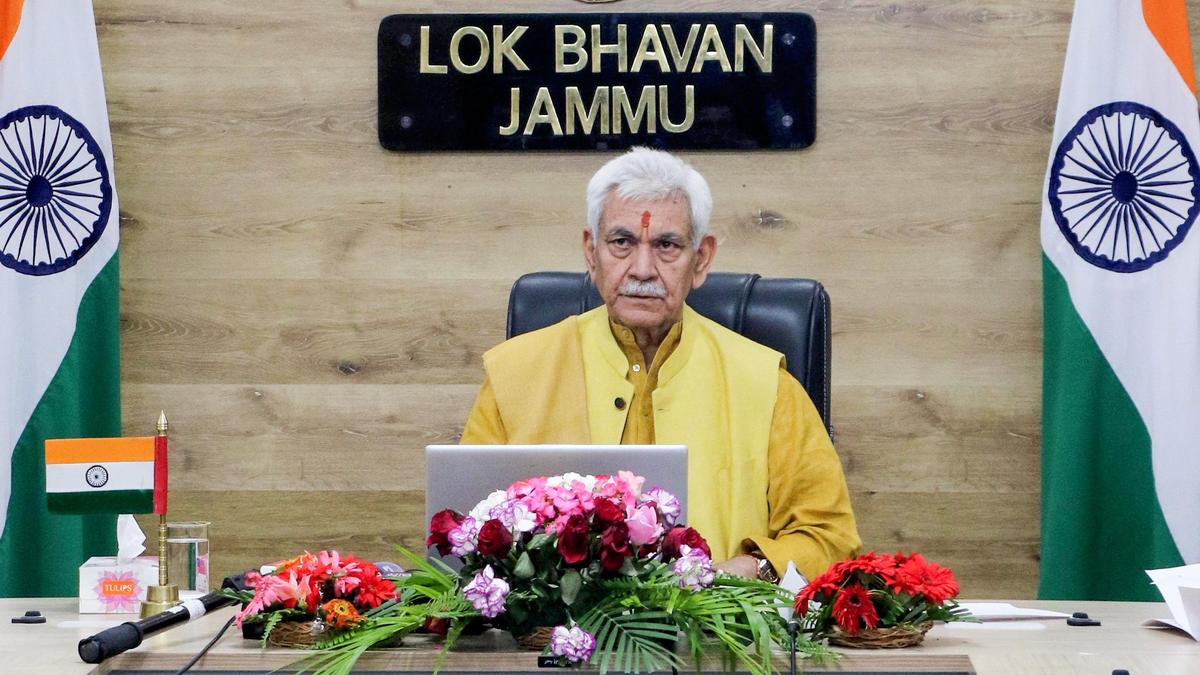
## Summary of The Hindu Article: J&K Lieutenant Governor Given Telecom Control Powers
The Jammu and Kashmir (J&K) administration has granted the Lieutenant Governor (L-G) sweeping powers over telecommunications, including the ability to intercept, monitor, and block communications during declared “public safety events.” This move, formalized through a recent government order, raises concerns about privacy and potential misuse.
The order empowers the L-G to authorize temporary suspension of telecom services – including mobile internet, voice calls, and broadband – within any area of J&K. This authority extends to directing telecom service providers to intercept, monitor, or block any electronic message or communication. Justification for these actions requires the L-G to be “satisfied that such measures are necessary in the interest of the sovereignty and integrity of India, security of the State, or public order.”
Previously, such powers rested with the Home Department. The new order centralizes control with the L-G, streamlining the process for imposing communication restrictions. Officials state this is intended to facilitate quicker responses during situations posing threats to public safety.
The order defines “public safety events” broadly, encompassing situations like potential terrorist attacks, communal tensions, or any event that could disrupt public order. Critics argue this broad definition allows for arbitrary application of restrictions.
This development follows a pattern of increased central control over J&K since the revocation of Article 370 in 2019. Frequent internet shutdowns have been a recurring feature in the region, particularly during periods of heightened security concerns or political unrest.
Legal experts point out the order needs to adhere to the principles of proportionality and necessity, as laid down by the Supreme Court in previous judgments regarding internet shutdowns. The order mandates that any interception or monitoring must be conducted in accordance with the Telegraph Act and the Information Technology Act.
The move has sparked debate regarding the balance between security concerns and fundamental rights, particularly the right to freedom of speech and expression. Civil society groups express apprehension that the expanded powers could be used to suppress dissent and limit access to information. The order’s implementation and its impact on civil liberties will be closely watched.